

Chiropractic · Long-length DR
Long-Length, Full-Spine, and Long-View DR for Chiropractic
If you want the short version: for most chiropractic full-spine rooms I start with the 2020 Imaging Universal 17×48. One exposure, a preview in under six seconds, and the measurement tools you already use. The other three are here because a real room sometimes needs a different answer. The detail is below if you want it.
Clinics ask for this four ways. A long-length panel. A full-spine detector. A long-view image. A long-form receptor. In an upright room those words are the same job — the whole spine in one exposure, not three 17×17 cassettes stitched after the patient has already shifted.
I walk the room in the order I would actually recommend it. 20/20 Imaging 17×48 is the easy fit. Fujifilm FDR D-EVO GL is next, usually because the office already lives in Fujifilm. Vieworks 17×51 when the requirement is simply more length. iCRco iDR-L so the CR option is named, and not dressed up as a flat panel. The matrix stays in sheet order. A dash means that figure was not published. It is not a zero. Prices stay off this page.
Quotes stay private. Call 720-600-3117. Generator and room fit are confirmed before a number goes out.
Panel matrix
Columns stay in sheet order: 2020 Imaging, Vieworks, Fujifilm, iCRco. They are equal width, grouped so a one-word cell and a long note are not pretending to be the same kind of box. The holder and grid rows are from the 2020 Universal DR quote. A dash means that figure was not published for that system. It is not a zero.
What those words mean for your room
Read the first bullet if you want the point. Read the second if you want the reason. Nothing here is a pitch. It is what I would tell you if you asked.
Type
- A flat panel is one exposure and a preview. A scanning plate is a wait.
- The 2020, Vieworks, and Fujifilm detectors are amorphous-silicon flat panels. The iCRco is a phosphor-plate scanner. If you have already left CR, you already know which category you want.
Active Area (inches)
- This is how much of the patient you actually see.
- Longer is what keeps the skull or the sacrum from getting cut off. Vieworks is 51 inches, Fuji is 49, and the 2020 is 48. For most chiropractic full-spine work I still start at 48. Length is not the only reason to choose.
Active Area (mm)
- The same field of view, in millimeters.
- You only need it if you want to check the pixel math yourself. That arithmetic is in the section below.
Pixel Pitch (µm)
- How far apart the pixels are. A smaller number can hold finer detail.
- 139 and 140 microns are where modern long-length DR sits. Fuji’s 150 is a step coarser. The 100-micron figure belongs to the CR scanner, and only in its slowest mode.
Nyquist / Spatial Resolution (LP/mm)
- The finest detail the detector can theoretically record. Higher is finer.
- 3.5 to 3.6 line pairs is strong for a long-length flat panel. Five line pairs looks best on a brochure. On a CR scanner that number is a scan mode, and the plate rarely delivers all of it.
Pixel Matrix (full)
- How many pixels are in the finished image.
- More pixels means more data, not automatically a better diagnosis. It is active area divided by pixel pitch. The 2020 matrix is not printed on the sheet. The math lands on 3064 × 8696.
Bit Depth
- How many shades of gray the detector can separate. 16-bit is 65,536 shades.
- All four are 16-bit. That is enough. This is not the line that should decide the room.
Image Preview Time
- How long you and the patient wait before a usable image is on the screen.
- The 2020 is under six seconds. Fuji’s full-length preview is 9 to 20 seconds. The iCRco is about 55 seconds while the scanner travels the plate. On a busy morning, that wait is the whole appointment.
Full Image / Cycle Time
- How long until the full image is ready and you can take the next view.
- Vieworks is about 8 seconds to acquire and 15 before the next shot. Fuji’s full-length cycle is about 26 seconds. The iCRco stays near 55. A shorter cycle is how a full-spine room stays on schedule.
Weight
- What the detector, or the whole stand, weighs.
- In a fixed room this rarely decides the purchase. Vieworks and Fuji are both about 43 pounds. The iCRco wall stand is about 100 pounds, which is a different piece of equipment. The 2020 panel weight was not published, so I am not going to guess it.
Dimensions
- Whether the detector physically fits the stand and the wall you already have.
- I measure that. I do not assume a brochure drawing matches your room.
Scintillator
- The material that turns the X-ray into light the detector can record.
- Cesium (CsI) is what I want named on a long panel. It uses the exposure more efficiently than Gadox or GOS. Fuji uses GOS and recovers some of that with ISS. Ask which version you are being quoted. It changes the dose.
Data Interface
- How the image leaves the detector and gets to the computer.
- A tethered high-speed cable is what I want in a stand that never moves. Fuji also needs its power supply and cable run. The iCRco needs a trigger cable to the generator.
Trigger Method
- How the detector knows you just exposed.
- Automatic exposure detection works with most generators already in the room, without a new cable. A hard trigger is an install. I confirm which one your generator can do before I quote.
Wireless Option
- Whether the detector can work without a data or power cable.
- None of these four are wireless. On a 48-inch panel that lives in a wall stand, I do not miss it. Wireless earns its place on a cassette you carry from room to room.
X-ray Range
- The kVp range the detector is specified for.
- Where it is published, 40 to 150 kVp covers normal diagnostic spine work.
Power
- What has to be plugged in at the stand.
- Fuji wants its own power supply. Confirm the outlet before the panel is on the way. The others are simpler, and I still look.
Operating Environment
- The temperature and humidity the detector is rated for.
- A normal clinical room is inside that range. This is not a reason to pick one panel over another.
Warranty
- How long the manufacturer stands behind the panel.
- The 2020 panel is a 60-month manufacturer warranty. The others were not stated on this sheet. I confirm those on the quote instead of filling in a blank.
Chiropractic Software
- Whether the tools on the screen are the ones you already use on a film or a tracing.
- Symmetry-Sync, which many of you still call Opal-RAD, is the set I trust for this work: Gonstead, Blair, Orthospinology, Cobb, Penning, labeling, and stitching when a study still needs it. The other panels need a separate conversation about software.
Special Technologies
- The manufacturer’s own processing, dose tools, or scan modes.
- On the 2020, REALISM holds trabecular detail without asking the tube for a heavier exposure. Fuji’s ISS, Virtual Grid, and Dynamic Visualization are the reason an existing Fuji room stays Fuji. Vieworks can shoot 17×34 or 17×17 on the same panel without pulling it out of the stand.
Generator Compatibility
- Whether the panel will fire with the generator you already own.
- Most AED panels will. The iCRco will not, until a trigger cable is installed. I look at the generator before a number goes out. That is the difference between a retrofit and a surprise.
Manufacturer Location / Support Base
- Who answers the phone on the day the room is down, and where the part ships from.
- 2020 is in Crystal Lake, Illinois. iCRco is in Goleta, California. Fuji’s US office is in Lexington. Vieworks supports the US from Vernon Hills and builds in South Korea. A domestic answer is a shorter down day.
Full-Spine Holder
- What holds the detector on the wall, and whether you can move it for the patient in front of you.
- The 2020 quote includes the wall-mounted Trans-Former™ cabinet: 25 inches of vertical travel and a rotating pivot clutch that turns the panel 90 degrees. Fuji and Vieworks did not publish an equivalent holder on this sheet. The iCRco is the wall stand itself.
Grid
- The grid cleans scatter before it reaches the detector. That is what keeps a long-spine image from looking gray.
- The Trans-Former uses a removable 8:1, 103-line parallel grid. Parallel does not lock you to one source-to-image distance the way a focused grid does, which matters when the anatomy is this long. The other systems did not publish a matching grid here.
Best For
- The short version, after everything above.
- 2020 when you want the chiropractic workflow and the software. Fuji when the room is already Fuji, or dose is the question you came in with. Vieworks when you truly need the longest field. iCRco only if you have read the CR trade-offs and still want it named.
How You Can Confirm The Numbers
You do not have to take a brochure’s word for the resolution. The short version: the published numbers agree with the pitches and the areas. If you want to see the work, it is in the table. The 2020 pixel matrix is not printed in the grid above. The same math lands on 3064 × 8696.
| Check | Formula | Result |
|---|---|---|
| 2020 Nyquist | 1 / (2 × 0.139 mm) = 3.60 LP/mm | 3.6 LP/mm |
| Vieworks Nyquist | 1 / (2 × 0.140 mm) = 3.57 LP/mm | 3.5 LP/mm |
| Fuji Nyquist | 1 / (2 × 0.150 mm) = 3.33 LP/mm | 3.3 LP/mm |
| iCRco 100 µm Nyquist | 1 / (2 × 0.100 mm) = 5.0 LP/mm | 5.0 LP/mm |
| 2020 matrix check | 424 mm / 0.139 mm ≈ 3050; 1207 / 0.139 ≈ 8683 | Matches 3064 × 8696 |
| Vieworks matrix check | 432 / 0.140 ≈ 3086; 1295 / 0.140 ≈ 9250 | Matches 3072 × 9216 |
| Fuji matrix check | 8228 × 0.150 mm ≈ 1234 mm; 2832 × 0.150 ≈ 425 mm | Matches active area |
| Weight conversion Vieworks | 19.7 kg × 2.2046 ≈ 43.4 lb | 43 lb |
| DPI from 100 µm | 25.4 mm/in ÷ 0.1 mm = 254 DPI | 254 DPI |
| DPI from 155 µm | 25.4 / 0.155 ≈ 164 DPI | 163 DPI |
| DPI from 200 µm | 25.4 / 0.200 = 127 DPI | 127 DPI |
The arithmetic only proves the published figures agree with each other. Your generator, the wall, and the full warranty language still get confirmed for your room. I will not treat a brochure as a promise.

2020 Imaging Universal 17×48 — where I start
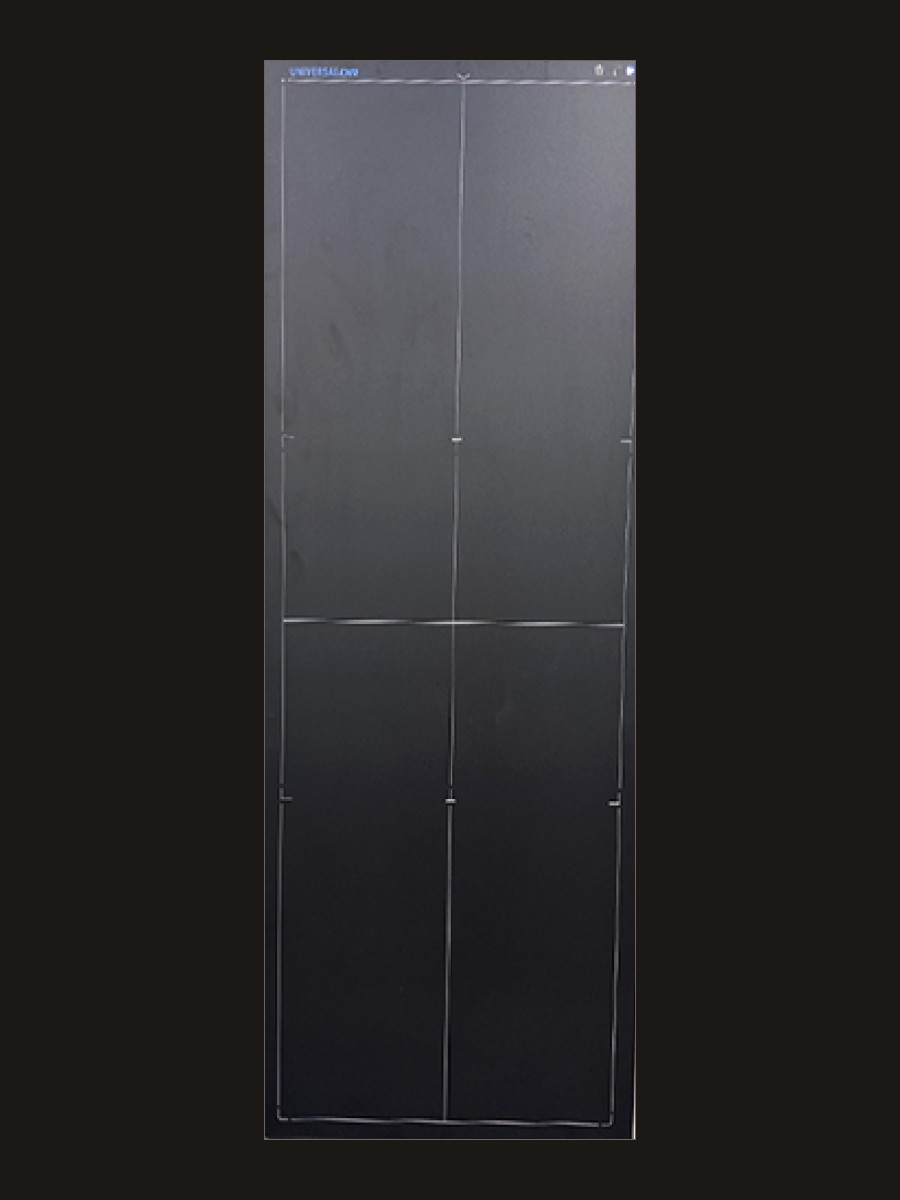
If the office is done stitching, this is the panel I put on the table first. One exposure, the upright spine, and a preview in under six seconds — before the patient has time to ask whether they can step down. Cesium, 17 × 48 inches, 139 µm, 3.6 LP/mm, 16-bit. Scoliosis and a true full-spine lateral belong on this class of detector. There is no seam and no second shot to hold.
The software is the other half of the decision. Symmetry-Sync, which a lot of doctors still call Opal-RAD, already knows the work: Gonstead, Blair, Orthospinology, George's lines, Cobb, Penning, spine labeling, and stitching when a study still needs it. REALISM™ is the processing that holds trabecular detail while the exposure stays modest. I have not found another long panel on this list that arrives with that chiropractic set already in the room.
It stays tethered on purpose. In a wall stand that never leaves the wall, I want the cable. Wireless earns its place on a cassette you carry between rooms. It is not a missing feature here. The sheet calls this detector cassette sized. That means one long receptor, not a 14×17 that drops into the tray you already have. AED covers most generators already on the floor, which is why a retrofit is realistic. I still look at the generator before a number goes out.
The panel is half of the install. The holder I quote with it is the Universal DR wall-mounted Trans-Former™. It is a full-spine grid cabinet made for this detector: 25 inches of vertical travel, a rotating pivot clutch that turns the panel 90 degrees, and a removable 8:1, 103-line parallel grid. Parallel matters on a long spine because you are not locked to one source-to-image distance the way a focused grid is. The panel carries a 60-month manufacturer warranty. A published weight for the detector alone was not on the sheet, so I will not invent one.
20/20 Imaging is in Crystal Lake, Illinois, a division of Konica Minolta Healthcare Americas. When a detector is down, a company that already answers the phone in the US is the difference between a domestic return and a shipment sitting in customs. See the 17×48 full-spine panel, the 20/20 Imaging page, and Symmetry-Sync. If the room is ready to be measured, the 17×48 room survey is the next step.

Fujifilm FDR D-EVO GL — next, for a reason
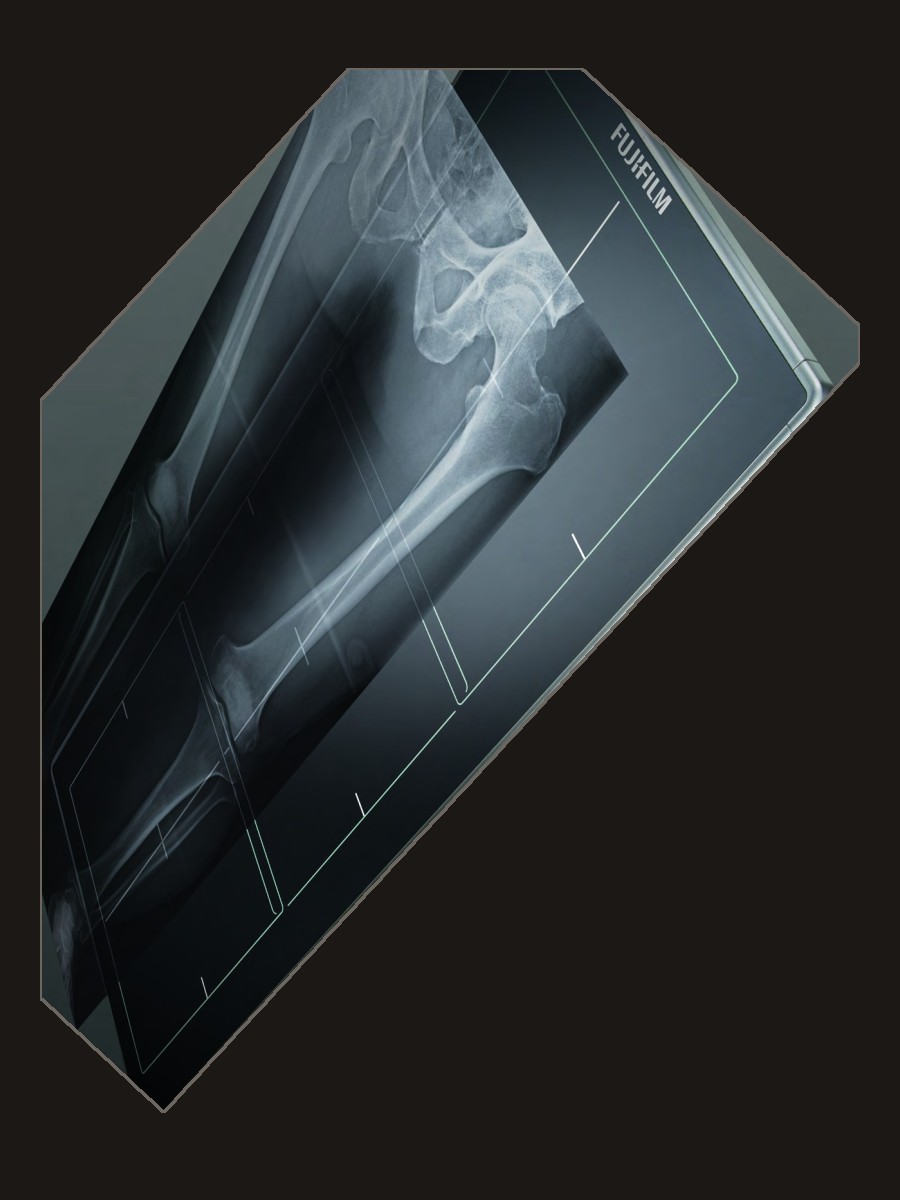
Fujifilm’s long-length detector is the FDR D-EVO GL: 17 × 49 inches, 150 µm, 3.3 LP/mm, GOS with ISS (irradiated side sampling). It is the second conversation I have, and almost always for a specific reason — the office is already on Fujifilm, or the doctor is asking about dose before anything else. It is not the longest panel here, and it is not the fastest. I do not lead with it just because the hardware photographs well.
A full-length preview is 9–20 seconds, about 6 seconds on a 17×17 segment. The full cycle is about 26 seconds, or 10 on that smaller segment. A busy chiropractic lineup will feel that next to a panel that previews in under six. Weight is about 43 lb. The detector is about 52.7 × 22.3 × 2.0 inches. It is wired: RS232C to the power unit, Ethernet to the workstation, and its own 120 VAC supply. There is no wireless version.
The reason to choose it is the Fujifilm toolset. ISS is how a GOS plate makes better use of the exposure. Virtual Grid is Fujifilm’s claim of up to 50% dose reduction versus a physical grid. Dynamic Visualization and the noise-reduction circuitry (listed at 1.7× DQE) belong to the same story. SmartSwitch is automatic exposure detection, so most generators do not need a new trigger cable. I still verify the generator. Warranty language was not in this matrix, so it gets confirmed on the quote.
Fujifilm Healthcare Americas is in Lexington, Massachusetts. The parent company is in Japan. A US office matters on the day a panel is down. More Fujifilm equipment we sell and service is on the Fujifilm page. The G80i is a different, shorter long-view detector — do not mix the two.

Vieworks VIVIX-S 17×51 — the long one
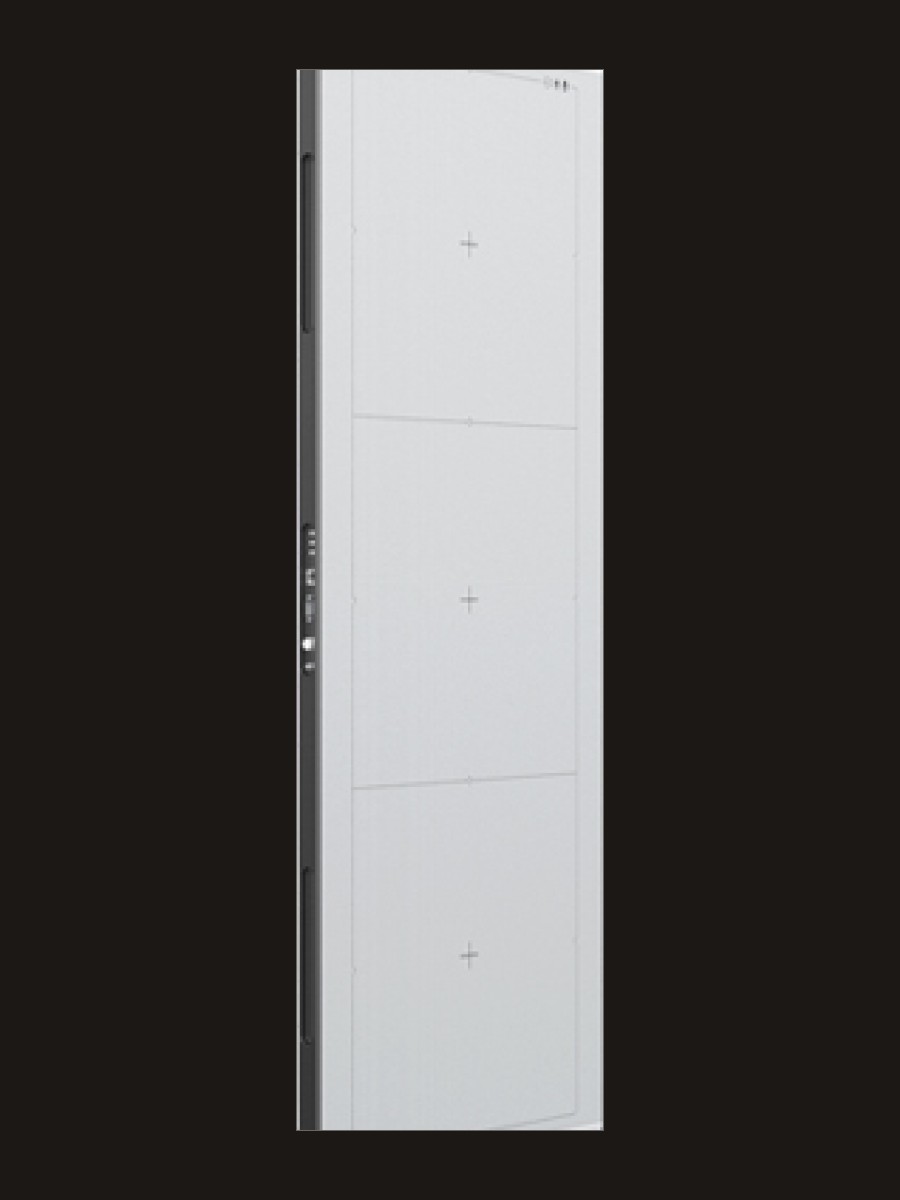
If the requirement is inches of anatomy, the Vieworks VIVIX-S 1751S wins the tape measure. Active area is 17 × 51 inches (430 × 1290 mm), and the 17×34 and 17×17 modes do not require moving the panel. Pixel pitch is 140 µm, Nyquist 3.5 LP/mm, full matrix 3072 × 9216, 16-bit. That is a modern flat panel, close to the 2020 on sampling, and longer than both the 17×48 and the Fuji 17×49.
Acquisition is about 8 seconds, with a 15-second recommended cycle. That is a workable long-view pace. Scintillator is CsI or Gadox, so the dose behavior depends on which version is quoted — CsI is the one I want named on the paperwork. The panel is about 19.7 kg (43 lb) and 135.7 × 53.2 × 3.0 cm. Power is DC 24 V at 3.0 A. The stated range is 40–150 kVp, which covers diagnostic spine work. Data is Gigabit Ethernet. Trigger is a DR trigger or AED. Both have to be checked against the generator in the room. There is no wireless option.
What it does not bring is the chiropractic software. Measurement tools would be a separate conversation. Multi-scan is the feature that earns it a place: a long spine, a shorter section, or a 17×17 region without pulling the detector out of the stand. That flexibility is real. It is also why I do not put Vieworks ahead of 2020, or ahead of an office that is already living in Fujifilm, for a typical chiropractic day.
Vieworks is headquartered in Anyang, South Korea, with US support in Vernon Hills, Illinois. The US office is what keeps parts and a person on this continent. Warranty was not published in this matrix. Confirm it, and confirm which scintillator, before the quote is treated as final. Service context is on the Vieworks page.
iCRco iDR-L — named, and a different machine
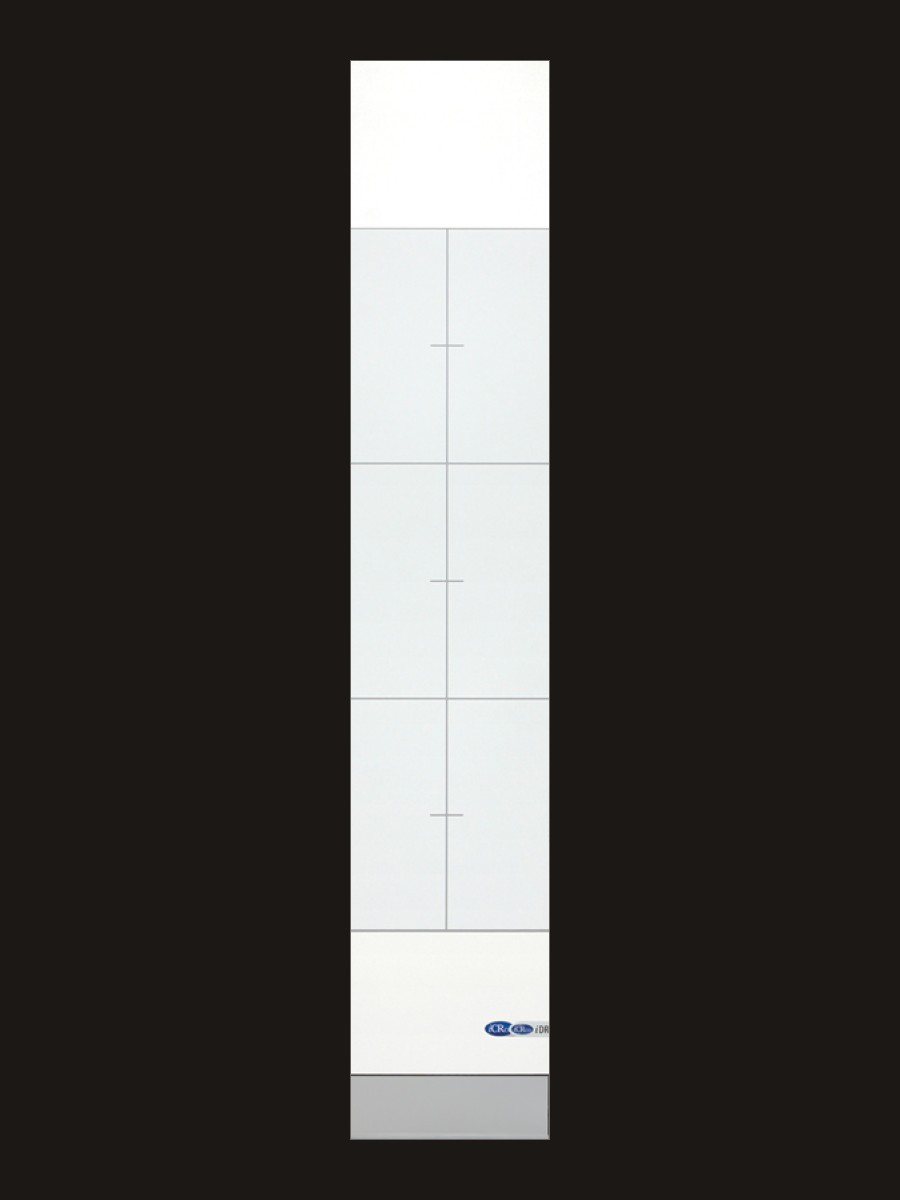
The iDR-L is here because a thorough long-length comparison should name it. It is not where I start. It is a scanning phosphor-plate system — CR — built as a tall wall stand, not a flat-panel DR detector. The scan area is 17 × 51 inches. That length looks competitive until the rest of the row is read.
Selectable scan modes are 100, 155, and 200 µm, published as 5.0, 3.1, and 2.8 LP/mm. Five line pairs is the best number on the page. It is also the mode that takes about 55 seconds while the scanner moves across the receptor. CR rarely delivers the theoretical Nyquist in a real image; laser spot size and plate blur take some of it back. A doctor who has already left CR for DR will recognize the category even when the brochure resolution looks strong.
The wall stand is about 100 lb, a different class of equipment from a detector that mounts in a stand you may already own. It needs a hard trigger cable to the generator. That is an install, not an AED retrofit. There is no wireless option and no chiropractic toolset in this comparison.
iCRco is a US manufacturer in Goleta, California, with support listed Monday through Friday, 8am–6pm Pacific. Being US-based is a real advantage for hours, shipping, and tariffs. It does not change the technology class. I mention the iDR-L so nobody later says it was skipped. I do not recommend it ahead of a modern long-length flat panel for an office that wants a single-exposure full spine and a short cycle.
What has to be true before a quote
The generator and the room get checked against the equipment already on the floor. AED panels usually work with most generators. The iCRco does not — it wants a trigger cable. Fuji wants its power supply and cable run. The 2020 and the Vieworks want a straight answer on AED versus a DR trigger. Wall space, ceiling height, and whether the existing stand can hold the detector get measured, not assumed.
Where the company sits changes a down day. 2020 in Crystal Lake and iCRco in Goleta are US companies. Fujifilm’s US office is in Lexington. Vieworks supports the US from Vernon Hills and builds in South Korea. That is the difference between a domestic RMA and a shipment that can sit in customs. I say so before anyone falls in love with a spec line.
I do not publish prices. A long-length room is quoted for that generator, that stand, and that software. Call 720-600-3117 or send the room details. The chiropractic page covers the rest of the upright room — straight-arm, DDR, and a cassette-sized upgrade when a 17×48 is more panel than the practice needs.
Questions clinics ask
What is a long-length or full-spine DR panel?
It is a single detector tall enough to cover a standing spine in one exposure. Clinics also call it a long-view or long-form panel. A 17×17 cassette cannot do that without stitching.
Is stitching three 17×17 images the same as a long-length detector?
No. Stitching is a workflow: three exposures, patient motion between them, and a software seam. A long-length flat panel is one exposure and one image.
Which long-length panel fits most chiropractic offices?
The 2020 Imaging Universal 17×48. It is a cesium flat panel, preview is under six seconds, and Symmetry-Sync is built for chiropractic measurement. The generator still has to be checked before anyone quotes it.
When would Fujifilm or Vieworks be the better fit?
Fujifilm FDR D-EVO GL belongs in a room that already lives on Fujifilm, or when the dose-reduction tools are the priority. Vieworks VIVIX-S 17×51 is the longest field of view, with 17×34 and 17×17 modes on the same panel.
Is the iCRco iDR-L a flat-panel DR detector?
No. It is a scanning phosphor-plate CR wall stand. The published 5 LP/mm figure is a scan mode, and a full-resolution read is about 55 seconds. It is on this page so the comparison is complete.